In today’s competitive digital landscape, businesses need technology that can adapt, grow, and evolve with their changing requirements. As organisations expand, their operational processes become more complex, customer expectations increase, and the demand for efficient digital solutions continues to rise. Traditional software or off-the-shelf applications may work well initially, but they often struggle to support long-term business growth.
This is where scalable custom software development solutions become essential. Custom software is designed around specific business requirements, helping organisations streamline operations, automate repetitive tasks, improve productivity, and deliver better customer experiences. More importantly, scalable software provides the flexibility to accommodate future growth without constantly replacing existing systems.
Whether you are a startup planning expansion, a growing company managing increasing workloads, or an established enterprise looking to modernise its technology infrastructure, investing in scalable custom software can make a significant difference.
Let’s explore why businesses need scalable custom software development solutions and how they contribute to long-term success.
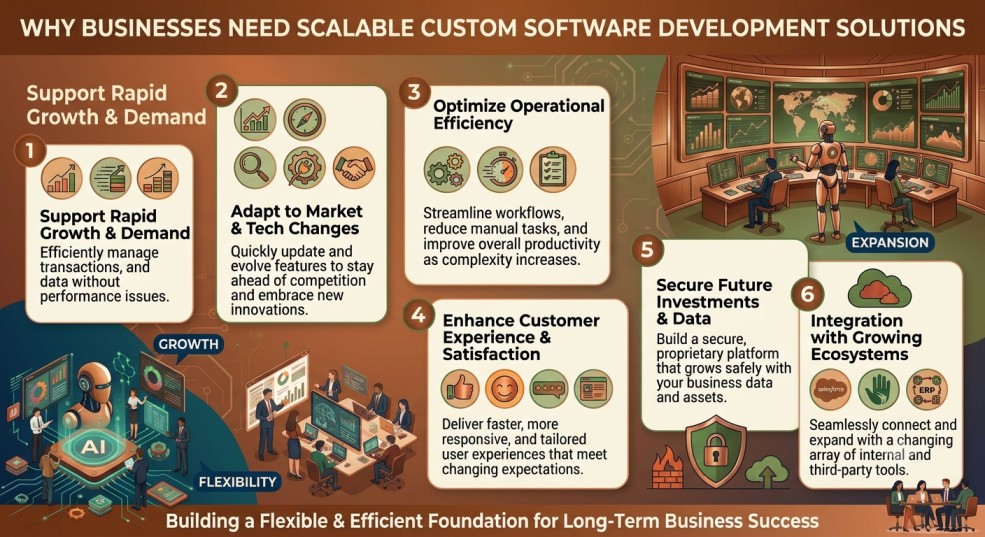
1. Supports Business Growth and Expansion
Every business aims to grow, but growth often brings new operational challenges. Increasing customers, expanding teams, additional services, and higher transaction volumes can put pressure on existing software systems.
Scalable custom software is developed to accommodate these changes without affecting overall performance. Businesses can introduce new features, integrate additional modules, and increase system capacity as their requirements evolve.
For example, an eCommerce business may initially operate with a limited product catalogue and customer base. As the business expands, it may need advanced inventory management, multiple payment gateways, customer analytics, and automated order processing.
A scalable software solution allows these capabilities to be introduced gradually, supporting business expansion without requiring a complete system replacement.
2. Designed Around Your Unique Business Requirements
Every organisation has different workflows, operational priorities, and business objectives. Ready-made software often includes standard features that may not fully address specific business requirements.
Custom software development offers greater flexibility by creating applications specifically around your business processes. Instead of adjusting your operations to fit existing software limitations, you can develop a solution that works according to your requirements.
Custom software can include specialised dashboards, automated approval systems, customer management tools, reporting features, and business-specific integrations.
This approach helps businesses improve operational efficiency while ensuring that the technology supports their actual working environment.
3. Improves Operational Efficiency Through Automation
Manual processes consume valuable time and increase the possibility of human errors. Businesses handling repetitive administrative tasks, data entry, customer enquiries, inventory updates, and internal approvals can benefit significantly from software automation.
Custom software development makes it possible to automate these processes according to specific organisational needs.
For example, an automated business management system can streamline employee workflows, generate reports, manage customer information, and track operational activities from a centralised platform.
Businesses can also integrate Artificial Intelligence (AI) and intelligent process automation to handle more advanced tasks, analyse information, and support faster decision-making.
By reducing repetitive work, employees can focus on strategic activities, customer relationships, and business development.
4. Provides Seamless Integration with Existing Systems
Most businesses rely on multiple digital tools to manage their daily operations. These may include CRM platforms, ERP software, accounting applications, inventory management systems, websites, and mobile applications.
When these systems operate independently, information can become fragmented, workflows may slow down, and teams may need to enter the same data multiple times.
Scalable custom software can integrate different business applications through APIs and other integration technologies, creating a connected digital ecosystem.
For example, integrating an eCommerce platform with inventory management and accounting software can automate order updates, stock tracking, and financial records.
This improves data consistency, reduces manual effort, and enables businesses to manage operations more efficiently.
5. Enhances Security and Data Management
Data security is a major concern for businesses operating in an increasingly connected digital environment. Customer information, financial records, business documents, and internal operational data must be protected against unauthorised access and potential security threats.
Custom software development allows businesses to implement security measures based on their specific requirements.
These may include role-based access controls, secure authentication, data encryption, activity monitoring, and regular security updates.
Businesses can also design their software architecture around applicable industry standards and data protection regulations.
A well-planned custom software solution provides greater control over data management and security configurations while supporting the organisation’s long-term technology strategy.
6. Offers Flexibility and Easy Future Upgrades
Technology requirements rarely remain the same over time. Businesses introduce new services, adopt different technologies, enter new markets, and change their operational processes.
Off-the-shelf applications may have limitations when it comes to customisation and future upgrades. In some cases, businesses may need additional subscriptions or separate tools to access the functionality they require.
Custom software provides the flexibility to modify existing features, introduce new modules, and adopt emerging technologies as needed.
For example, a business management application can initially include customer and employee management features. Later, it can be expanded with AI-powered analytics, automated reporting, mobile accessibility, and advanced workflow management.
This adaptability helps businesses maintain a technology infrastructure that evolves alongside their objectives.
7. Improves Customer Experience and Business Performance
Customer experience plays an important role in business growth and customer retention. Slow applications, disconnected systems, and inefficient service processes can negatively affect customer satisfaction.
Scalable custom software helps businesses create smoother digital experiences through personalised functionality, faster processing, and improved accessibility.
For example, businesses can develop custom customer portals, mobile applications, self-service platforms, and AI-powered chatbots to make interactions more convenient.
These solutions can help customers access information, track orders, submit requests, and receive assistance without unnecessary delays.
Better customer experiences can strengthen relationships, improve engagement, and contribute to long-term business growth.
8. Reduces Long-Term Technology Costs
Although custom software development may require a higher initial investment than purchasing ready-made applications, it can offer better long-term value.
Businesses using multiple third-party tools may face recurring subscription fees, additional integration expenses, licensing restrictions, and limitations on customisation.
Custom software can consolidate several business functions into a single platform, reducing dependency on multiple disconnected applications.
Furthermore, scalable architecture allows organisations to introduce improvements gradually instead of replacing their entire software infrastructure whenever business requirements change.
The overall return on investment depends on development costs, maintenance, infrastructure, and business benefits. However, a properly planned custom software solution can help control long-term technology expenses.